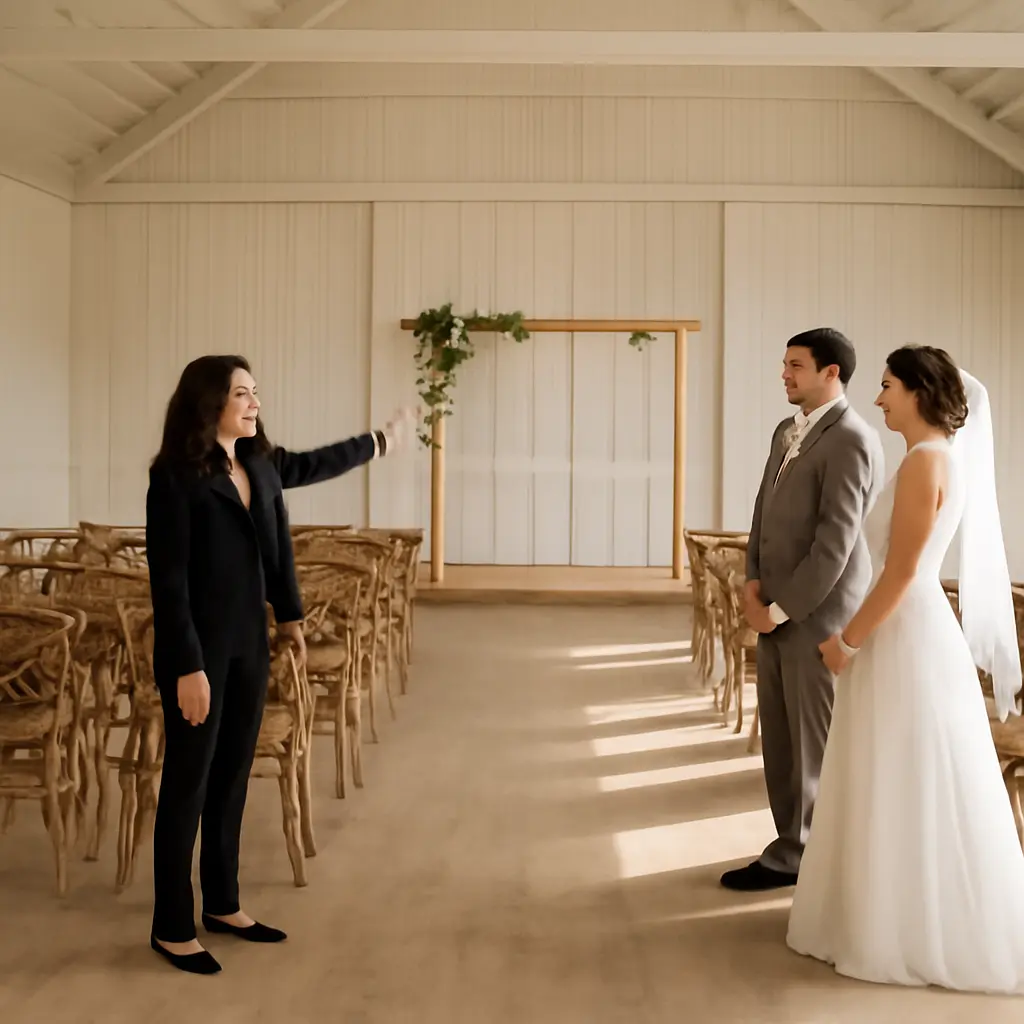
A wedding rehearsal is a short, guided practice of the ceremony—not a full production run of the entire wedding day. The stress-saving version focuses on the processional, where people stand, key cues, and the recessional, while avoiding common time-wasters such as inviting too many participants, debating every detail, and trying to rehearse the reception as well. This matters because wedding planning already involves substantial coordination: The Knot’s 2024 Real Weddings Study reported an average U.S. wedding cost of $33,000 in 2023, excluding the honeymoon. A clear plan, a designated leader, and a firm stopping point can keep rehearsal from adding unnecessary hours of pressure.
Rehearsal planning reduces avoidable wedding-day stress
A wedding rehearsal is a brief, practical walkthrough of the ceremony’s sequence and participants’ movements. It is not a test of whether anyone can perform perfectly, nor does it need to settle every choice about décor, photography, or reception logistics. Wedding-planning guidance from The Knot and Brides commonly emphasizes practicing the ceremony’s order, entrances, standing positions, and exits so participants know what to do when the actual event begins.
The distinction matters: A rehearsal can clarify decisions already made, but it is an inefficient place to make decisions that require consultation or approval. Couples can save time by separating ceremony practice from a venue walkthrough, family discussion, photo planning, and reception run-through. The most useful rehearsal is usually the one that ends once everyone understands their cues.
Treat the rehearsal as a ceremony walkthrough
A walkthrough is a sequence-based practice: participants enter, take their places, respond to the necessary cues, and exit. It generally does not require repeated full readings, polished delivery, or practice of every musical passage. The officiant or coordinator can explain the order, demonstrate the movement, and run the sequence once more if a specific transition remains unclear.
This approach also keeps attention on the moments most likely to cause confusion: who enters first, which side each person stands on, where bouquets go, when the couple turns, and what signal begins the recessional. A simple printed sequence or shared phone note can serve as a reference without turning the rehearsal into a meeting.
Separate rehearsal from wedding-day production planning
Production planning covers matters such as vendor arrival times, sound checks, table layouts, photo lists, and transportation. Those are important, but they do not all belong in a ceremony rehearsal. When couples mix these tasks together, a short practice can expand into a long, unfocused discussion.
For example, a question about where the photographer will stand can be recorded for the photographer or coordinator rather than debated by the full wedding party. A question about ceremony order belongs with the officiant and the people taking part. Assigning each question to the right person preserves rehearsal time and reduces repeated conversations.
Common rehearsal mistakes create delays and uncertainty
The most common rehearsal problems are organizational rather than ceremonial: unclear leadership, too many people involved, decisions left until the last minute, and attempts to practice details that do not affect participants’ movements. These mistakes can compound. If nobody owns the schedule, small questions lead to side conversations; if the group is large, each conversation takes longer to resolve.
The American Psychological Association describes stress as a response to demands or pressures, and notes that persistent stress can affect well-being. A rehearsal is not a clinical stress intervention, but reducing uncertainty and unnecessary demands is a practical way to make this planning task easier. The following mistakes are especially avoidable.
Mistake: Rehearsing without a designated leader
A rehearsal leader is the person authorized to explain the sequence, answer routine questions, and move the group from one step to the next. This may be the officiant, planner, venue coordinator, or another agreed-upon person. Without one, several people may give conflicting directions, while the couple is left to resolve every detail.
Name the leader before the group arrives, and make clear which decisions they can settle. If a question requires the couple’s preference, the leader can present the options and ask for a quick decision. If it concerns a vendor’s technical setup, the leader can assign it to that vendor instead of holding the whole group in place.
Mistake: Inviting people who do not need to rehearse
A rehearsal participant is someone whose role requires knowing when and where to move during the ceremony. That usually includes the couple, officiant, wedding party, and any readers or attendants with a specific cue. Guests, extended family, and vendors who have no ceremony movement to practice may not need to attend the walkthrough.
A larger group is not automatically a better-prepared group. Each additional attendee creates more opportunities for late arrivals, questions, and side discussions. Share essential information with guests separately—for example, arrival time, seating guidance, and venue entry instructions—rather than making the rehearsal a briefing for everyone.
Mistake: Leaving basic decisions until the rehearsal
The rehearsal is for practicing settled choices, not negotiating them from scratch. Unresolved questions about the processional order, music cues, readings, or where family members sit can cause a group to stop repeatedly. Couples can prevent this by sending a simple ceremony outline to the officiant and rehearsal leader in advance.
Not every choice needs elaborate documentation. A one-page plan can list the order of entry, standing positions, readers, musical cues, and exit order. If a detail is still undecided, identify the person responsible and set a decision deadline before rehearsal day.
Mistake: Trying to perfect every movement and speech
A rehearsal should establish reliable cues, not demand performance-level polish. Repeating a walk because someone’s pace was slightly different, practicing vows that are meant to be private, or restarting the ceremony after a minor stumble can consume time without improving readiness.
Focus on functional questions: Can participants hear the cue? Do they know where to stand? Is there enough room to pass? Does the officiant know when the music should change? If the answer is yes, the group can move on. A relaxed, understandable sequence is more useful than a flawless rehearsal performance.
A simple rehearsal structure keeps the group moving
A time-boxed structure gives participants confidence about what will happen and when they can leave. The exact duration depends on the ceremony’s complexity and venue access, so there is no universal evidence-based rehearsal length. The practical principle is to reserve enough time for one clear walkthrough, a targeted correction, and a final question check—rather than allowing the session to expand without a plan.
The following sequence is a useful template, not a rigid rule. A planner or officiant should adapt it for cultural traditions, accessibility needs, venue restrictions, and the ceremony format.
Use a short agenda with a firm end time
A focused agenda can include a quick orientation, the processional, positions and transitions, the recessional, and a final check for unresolved practical questions. Tell participants the expected finish time in advance. A stated endpoint helps prevent optional discussions from taking over the session.
- Confirm who is leading and who needs to be present.
- Explain the ceremony order and demonstrate the main cues.
- Walk through entrances, standing positions, and the exit.
- Repeat only transitions that were genuinely unclear.
- Record remaining questions with a named person responsible for each.
Share a concise ceremony outline beforehand
A ceremony outline is a brief written reference showing the order of events and the people responsible for each part. It might include music cues, processional order, reader names, and the recessional. Sharing it ahead of time allows participants to spot missing information before they are standing together at the venue.
The outline should be practical rather than exhaustive. It does not need to reproduce every word of the ceremony if participants do not need that information to rehearse. For accessibility, provide information in a format participants can use, and ask in advance whether anyone needs an accommodation such as a seated practice, extra transition time, or a clear route through the space.
Use a question parking lot for off-topic decisions
A question parking lot is a written list of issues that arise during rehearsal but do not need an immediate group decision. For instance, a question about reception seating can go to the planner, while a sound-system question can go to the audio vendor. This technique protects the ceremony walkthrough from unrelated planning tasks.
At the end, review the list with the appropriate decision-makers and assign a next step. This turns interruptions into manageable follow-up instead of allowing them to become unresolved background stress.
Real-world scenarios show where rehearsal time disappears
The same pattern appears across different wedding formats: time is lost when a practical cue is mixed with a larger decision or when the group waits for information that should have been settled earlier. These examples illustrate how a small process change can keep rehearsal focused.
A processional order becomes a family negotiation
Suppose relatives disagree about who should walk with whom. If that discussion begins after everyone has assembled, the rehearsal leader cannot practice the entrance until the issue is settled. The time-saving alternative is to agree on the order beforehand, consult the couple about any sensitive family dynamics, and give the leader a final written list.
A venue walkthrough turns into a décor review
A group may notice floral arrangements, signage, or furniture placement while practicing at the venue. Those observations can be useful, but they need not stop the ceremony run-through unless they block movement or access. The leader can note the issue for the florist, venue team, or planner and continue.
A participant’s cue is unclear and gets repeated unnecessarily
If a reader does not know when to approach the microphone, the group may repeat multiple sections of the ceremony. Instead, clarify the cue directly—such as the officiant’s signal or a specific musical transition—and practice that moment once. This solves the actual problem without restarting the entire sequence.
Conclusion: A focused rehearsal protects time and peace of mind
A wedding rehearsal works best as a concise ceremony walkthrough led by one designated person. The main sources of wasted time are unclear leadership, unnecessary attendees, unsettled decisions, perfectionism, and unrelated planning conversations. A short agenda, a shared ceremony outline, and a parking lot for off-topic questions can turn those problems into manageable tasks.
Before rehearsal day, confirm the participant list, settle the ceremony order, identify the leader, and communicate the end time. Then practice the cues that matter and let the rest of the wedding plan proceed through the appropriate people. For additional guidance, consult your officiant, planner, or venue coordinator about the requirements and traditions specific to your ceremony.
Sources: The Knot, “The Average Wedding Cost in 2023,” 2024 Real Weddings Study, https://www.theknot.com/content/average-wedding-cost; Brides, “How to Plan a Wedding Rehearsal,” https://www.brides.com/story/how-to-plan-a-wedding-rehearsal; American Psychological Association, “Stress: The Different Kinds of Stress,” https://www.apa.org/topics/stress/types-of-stress