
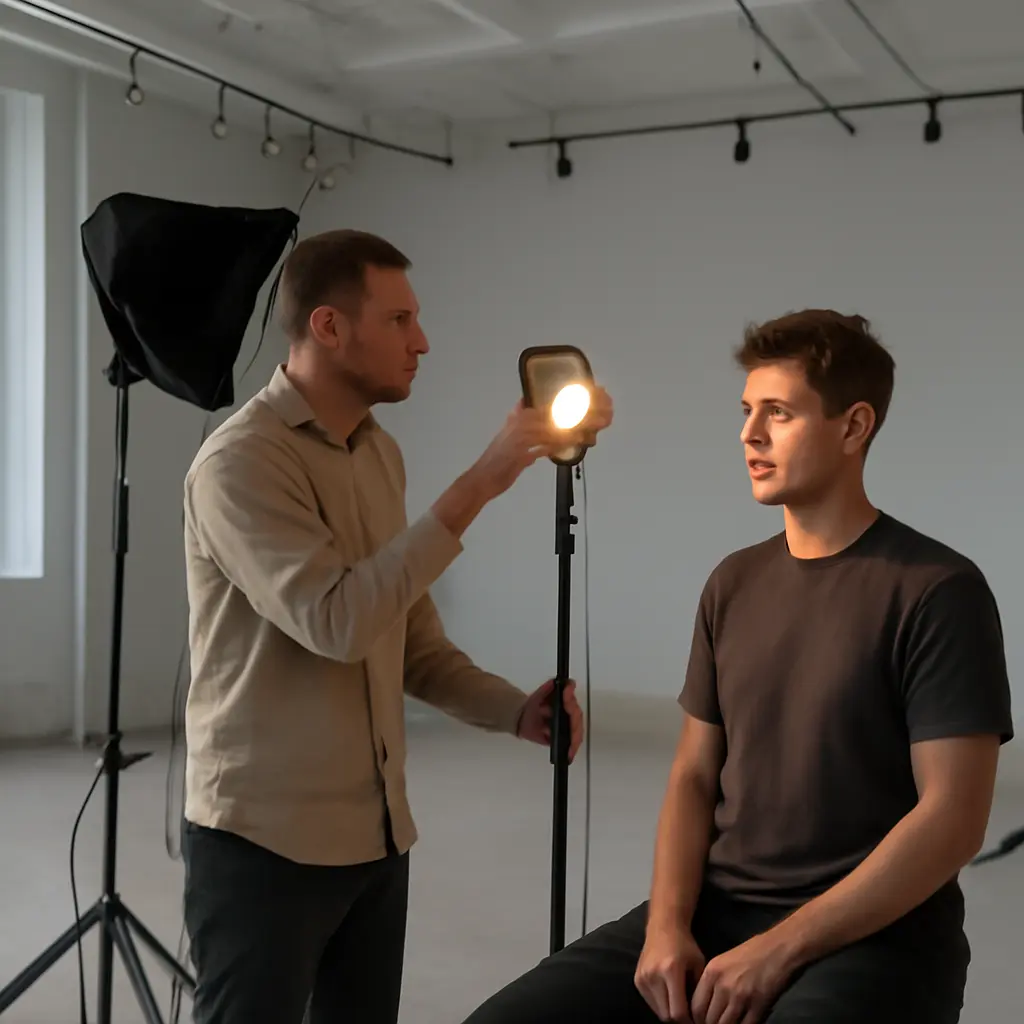
Warm uplighting and cool spotlights can both flatter skin, but neither is universally better: the result depends on the light’s color, direction, intensity, and the person’s complexion. Warm, diffused light often gives skin a softer, golden appearance, while a well-balanced, high-quality cool spotlight can reveal natural detail and keep colors from looking overly orange. The practical choice is to test the actual fixtures on people in the space, because color temperature alone does not determine how skin will look.
Lighting color and direction shape how skin tones appear
Skin-tone appearance under lighting is the perceived color and visual texture of skin when a light source illuminates it. The Illuminating Engineering Society (IES) explains that a source’s color appearance is described in part by correlated color temperature (CCT), measured in kelvins, while color rendering describes how faithfully that source shows object colors compared with a reference. Those are separate properties: a warm source is not automatically flattering, and a cool source is not automatically accurate.
Common lighting categories include warm-white light, typically around 2700–3000 K; neutral or mid-white light, often around 3500–4000 K; and cool or daylight-like light, commonly around 5000–6500 K. These ranges are conventions, not guarantees about how a fixture will look. The U.S. Department of Energy notes that CCT describes whether light appears warm or cool, while color-rendering metrics address how colors are revealed. For skin, both matter, as do shadows and glare.
Warm uplighting: soft, but sensitive to placement
Uplighting sends light upward toward a wall, ceiling, or architectural surface, which then reflects it into the room. With a warm-white source, that indirect bounce can create a gentle, amber atmosphere and soften facial shadows. It is often flattering in lounges, restaurants, and event spaces when the reflected light is broad and the walls are neutral.
The trade-off is that light traveling upward can create shadows beneath the brow, nose, and chin when it reaches a face from below. Warm light can also push skin toward orange or yellow, especially when the fixture has poor color rendering or the surrounding surfaces are strongly colored. Uplighting is therefore most dependable as ambient fill, not as the only light on a face.
Cool spotlights: clear, but potentially harsh
A spotlight concentrates light into a narrower beam. A neutral-to-cool spotlight can make a face look crisp and can preserve a less amber impression of whites and clothing, which is useful for presentations, galleries, and photography. But a small, direct source can create hard shadows, shiny highlights, and strong contrast; those effects may emphasize texture rather than flatter it.
Coolness itself does not guarantee accuracy. A fixture’s spectral output and color-rendering performance influence whether reds, browns, and other skin-related hues look natural. The IES and lighting manufacturers commonly report color quality using measures such as the Color Rendering Index (CRI), though CRI has limitations and a high score alone does not promise a flattering result. Check the fixture’s specifications and, more importantly, evaluate it on people in context.
Because direction and softness can matter as much as CCT, the most useful comparison is not simply warm versus cool. It is warm, indirect light versus cool, concentrated light—a comparison that changes several variables at once. For a fair test, compare similar brightness and beam coverage, then assess color and shadow separately.
Skin-tone flattering depends on color quality and lighting design
A flattering setup lets skin appear believable while controlling distracting shadows, glare, and color casts. That usually means using a source with good color rendering, choosing a CCT suited to the room’s purpose, and placing light near or slightly above eye level rather than relying on a beam from below or a single overhead source. There is no single kelvin value that works equally well for every complexion, room, and camera.
Color temperature and color rendering are different
CCT tells you whether a light looks visually warm or cool; it does not tell you how accurately it renders skin colors. CRI is a familiar color-rendering index, scored on a scale where higher values generally indicate closer resemblance to a reference for the test colors. For areas where people are a focus, a high-CRI fixture—often specified at CRI 90 or above—can be a useful starting point, but it is not a substitute for a visual test.
Some newer specifications, including IES TM-30, provide additional measures of color fidelity and gamut. These can help lighting professionals compare sources more fully than a single CRI number. In practice, check the fixture’s full color-quality data when available, and inspect how it renders a range of skin tones rather than judging it by a white wall or product label alone.
Direction, softness, and brightness affect perceived complexion
A large or bounced source spreads illumination over a wider area, generally producing softer transitions between light and shadow than a small bare spotlight. For faces, a broad source placed near the front and slightly above eye level often looks more natural than strong uplight or a steep overhead beam. A reflector, pale wall, or diffused fixture can soften a spotlight without changing its CCT.
Brightness also matters. Excessively intense light can wash out color and create specular shine; too little light may make faces look dull or cause cameras to raise exposure and noise. The Illuminating Engineering Society’s lighting recommendations vary by task and setting, so there is no universal illuminance target for every social space. Set the level for the activity, then judge faces at that level rather than testing a fixture at an arbitrary maximum.
Room surfaces can tint the light
Reflected light takes on some of the color of the surface it bounces from. A warm uplight aimed at a red, wood-toned, or cream wall may return a stronger warm cast; a cool spotlight against a blue wall can make the overall scene feel even cooler. Neutral, light-colored surfaces are generally easier to predict, while saturated finishes should be included in any on-site lighting test.
This is why a lighting choice that looks appealing in a showroom can behave differently in a restaurant, event hall, or home. Test fixtures alongside the actual wall colors, furnishings, and other lamps. Mixed sources with very different CCTs can also create uneven color across a face, especially when one side is lit by warm ambient light and the other by a cool beam.
Once color quality, softness, and the room’s reflective surfaces are considered, the choice can be made according to the use of the space rather than a broad rule about warm or cool light.
Choose the setup for the setting, not just the Kelvin number
For events, dining, and hospitality
Warm uplighting can work well for atmosphere, especially when it bounces off neutral walls and is paired with gentle, face-level fill. Avoid aiming strong light upward directly at guests’ faces. If photos are important, make sure the photographer’s lighting is consistent with the room’s ambient color; otherwise, images may show unexpected orange, blue, or mixed casts.
For portraits, video, and on-camera appearances
Prioritize controllable, soft frontal light and reliable color rendering. A neutral-white key light is a practical starting point, but the best CCT depends on the camera’s white balance and the intended look. Warm ambient uplighting can remain in the background, while the face is lit separately with a broad, diffused source. Always check the result on the camera or display that will be used.
For practical testing
- View several people with different complexions under the actual fixtures and room finishes.
- Compare options at similar brightness, and note CCT, CRI, and TM-30 information where available.
- Check faces from normal viewing positions for orange or blue casts, under-eye shadows, shine, and uneven color.
- Repeat the test with any cameras or displays that matter, because camera white balance can change the recorded result.
A simple comparison chart can help: list each fixture’s CCT, color-rendering data, direction, brightness setting, and observed skin appearance. This makes the decision more reliable than choosing by a product photo or kelvin rating alone.
Conclusion: balanced, soft light is usually the safer choice
Warm uplighting can create a flattering, relaxed atmosphere, but it may add an unwanted amber cast or produce awkward shadows from below. Cool spotlights can keep a scene crisp, yet their concentrated beams may exaggerate texture and contrast. Skin-tone appearance depends on the combination of CCT, color rendering, direction, softness, brightness, and reflected colors—not on “warm” or “cool” alone.
For most spaces where people’s faces matter, start with high-quality, soft, front-facing light, then use warm uplighting or cool accents for atmosphere. Test the real fixtures on a range of complexions in the finished room before committing. For further guidance, consult the Illuminating Engineering Society’s color-quality resources and the U.S. Department of Energy’s lighting guidance.
Sources: Illuminating Engineering Society, The Lighting Handbook, 10th Edition, https://www.ies.org/product/the-lighting-handbook-10th-edition/; Illuminating Engineering Society, IES TM-30-24: Method for Evaluating Light Source Color Rendition, https://www.ies.org/standards/; U.S. Department of Energy, LED Lighting, https://www.energy.gov/energysaver/led-lighting; U.S. Department of Energy, Color Quality, https://www.energy.gov/eere/ssl/color-quality


