Wedding style is most meaningful when it translates a couple’s shared history, values, and preferences into choices guests can see and experience—not when it simply reproduces a popular Pinterest board. A practical way to do this is to begin with personal stories, turn those stories into a small set of design principles, and then apply them consistently to the venue, flowers, food, music, and ceremony. The approach also makes room for trends without letting them dictate the celebration: The Knot’s 2024 Real Weddings Study reported that couples spent an average of $33,000 on weddings in 2023, a substantial investment that makes thoughtful, personally relevant decisions especially valuable.
Wedding style expresses a couple’s story through design choices
Wedding style is the coordinated visual and sensory character of a celebration, shaped by choices such as color, materials, setting, clothing, food, sound, and ceremony. There is no single formal authority that defines “story-rooted wedding style”; for this article, it means a design approach in which those choices are informed by the couple’s actual experiences and priorities. Wedding planners and designers often describe the practical work as translating a couple’s preferences into a coherent design concept. In this approach, the source material is not a trend forecast but the couple’s own life together.
The relevant evidence is not that a certain flower or palette guarantees a more meaningful wedding. Rather, surveys show how much planning and spending are involved. The Knot’s 2024 study drew on nearly 10,000 U.S. couples married in 2023 and reported an average wedding cost of $33,000, with costs varying considerably by location and guest count. That figure is a reminder to use a clear point of view: a personal design principle can help couples decide where to invest and what they can comfortably leave out.
Personal narrative as the design brief
A personal narrative is the set of experiences, relationships, places, and values that gives a wedding its particular meaning. It might include where a couple met, a family tradition, a shared hobby, a favorite meal, or the way they want guests to feel. A narrative is not a requirement to turn every detail into a symbol; it is a source of clues for making choices that feel recognizable to the couple.
Start by separately answering questions such as: What do we love doing together? Which places feel like home? What do we want guests to remember? Are there cultural or family customs we want to honor, adapt, or leave aside? Compare answers and look for overlap. Three recurring ideas—such as “coastal, relaxed, and family-centered”—are more useful than a long list of disconnected motifs.
Design principles turn the story into usable criteria
Design principles are short decision rules that connect a story to practical choices. For instance, “make the day feel like a welcoming dinner party” can guide the table layout, food service, lighting, and music. “Celebrate our city’s creative community” might suggest locally made signage, a neighborhood venue, and a playlist that reflects the couple’s social life. These principles let the story guide decisions without requiring a literal theme.
To test a proposed detail, ask whether it reflects a real preference, supports the guest experience, and fits the budget. If it does none of these, it may be a trend-led extra rather than a meaningful choice. This simple filter helps carry the narrative into the wedding’s individual elements.
Story-rooted wedding style links personal details with guest experience
A wedding’s story is most effective when it appears through a few connected details rather than a collection of explanations. The design can communicate through atmosphere, materials, rituals, and hospitality. This creates several useful categories of story-led styling: place-based design, meaningful objects and rituals, and guest-centered choices.
Place-based design connects a wedding to its setting
Place-based design uses the character of a meaningful location—such as a hometown, family property, or shared travel destination—as an influence on the celebration. Instead of copying a destination wedding aesthetic, couples can draw from the real environment: local food, regional flowers, landscape colors, or materials that suit the venue. A couple who often hikes in the mountains, for example, might choose a lodge, seasonal greenery, and a relaxed outdoor ceremony, without turning the event into a literal camping theme.
The U.S. Environmental Protection Agency’s sustainable materials guidance encourages considering a product’s life cycle, including its source, use, and disposal. Applied to wedding design, that perspective can support choices such as renting decor, using seasonal flowers, and working with nearby suppliers when practical. Local sourcing is not automatically cheaper or more sustainable, so couples should compare availability, transport, labor, and reuse options rather than rely on a label alone.
Objects and rituals can carry family or cultural meaning
A meaningful object or ritual is a physical item or shared practice that represents a relationship, heritage, or family connection. It might be a relative’s recipe, a piece of fabric incorporated into attire, a ceremony tradition, or a photograph displayed with context. The strongest details have a clear connection to the couple and are included with care, especially when a tradition comes from a culture or community to which the couple does not belong.
The Pew Research Center’s work on marriage and family documents the diversity of family structures and experiences in the United States. That diversity matters in wedding planning: there is no universal family template. Couples can honor chosen family, blended families, deceased loved ones, or cultural traditions in ways that reflect their circumstances, while discussing sensitive choices with relatives or cultural advisers where appropriate.
Guest-centered design makes the story welcoming
Guest-centered design considers how people will move through, understand, and enjoy the celebration. Personal style should not come at the expense of comfort or accessibility. Clear directions, seating that supports conversation, food options that account for dietary needs, and a realistic schedule help guests participate in the couple’s story rather than merely observe its decoration.
The U.S. Centers for Disease Control and Prevention estimates that one in four U.S. adults has a disability. While a wedding is not a clinical setting, this widely cited statistic underscores why access deserves early attention. Ask venues about step-free routes, accessible restrooms, seating, sound, and transport; provide key information in advance; and offer a way for guests to communicate access needs privately.
A clear process keeps wedding inspiration personal rather than trend-led
Once a couple has identified its story and design principles, a simple process can keep decisions consistent. Pinterest, magazines, and social media can still be useful for discovering options, but they work best as reference libraries—not as instructions. The goal is to evaluate inspiration against the couple’s own criteria.
Build a shared brief before collecting inspiration
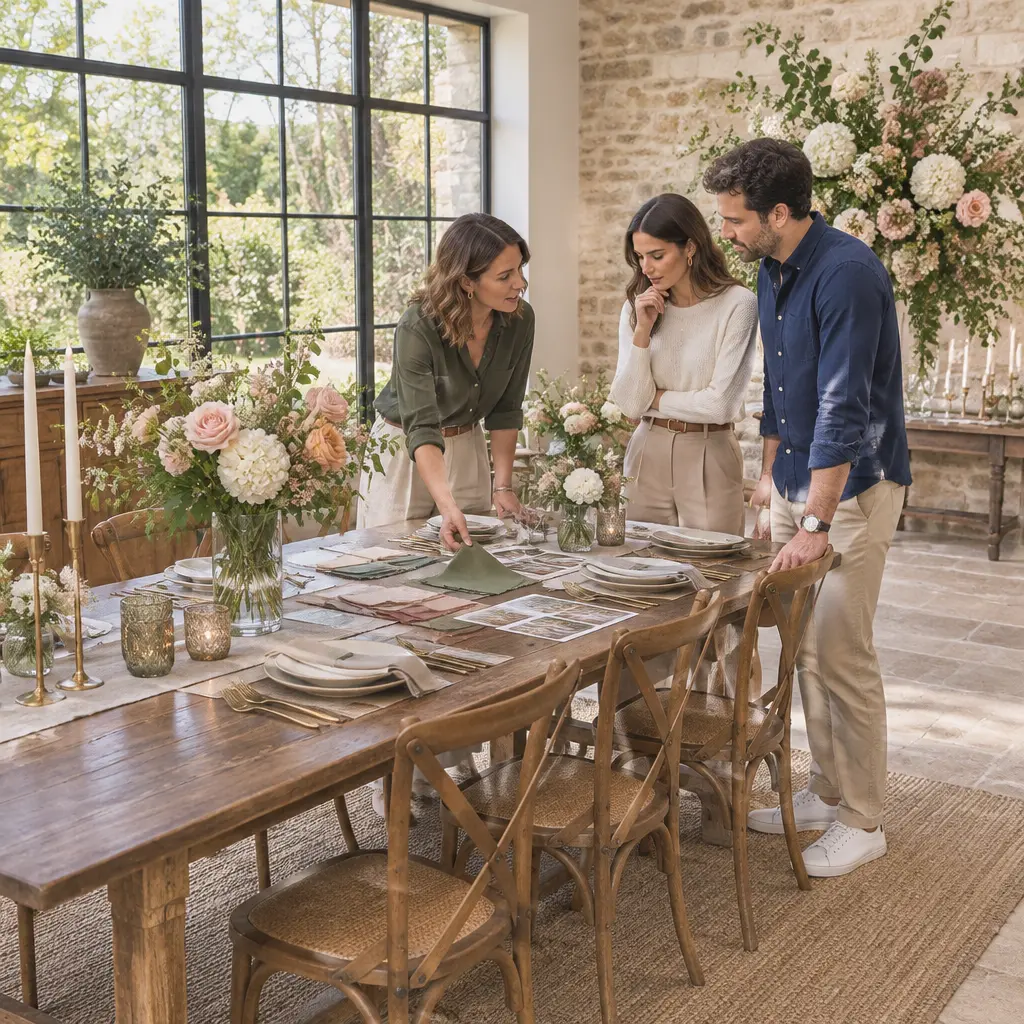
A shared brief is a short document that records the couple’s priorities, practical limits, and desired atmosphere. Include a budget range, guest count, venue constraints, accessibility needs, and three to five design principles. Then collect images or examples that support those principles. Label each reference with what appeals to you—such as the lighting, relaxed seating, or seasonal color—rather than saving an image as an all-or-nothing template.
This method also helps distinguish a visual preference from a complete plan. A photograph may show an elaborate installation that is unsuitable for the venue or budget, while the underlying idea—warm candlelight, a natural palette, or a communal table—may be adapted in a realistic way.
Use a decision filter to evaluate trends
A decision filter is a repeatable set of questions for accepting, adapting, or declining an idea. For each trend or vendor proposal, ask:
- Does this reflect something we genuinely like or value?
- Does it support the atmosphere or guest experience we want?
- Can it work within our budget, venue, and schedule?
- Can it be adapted to feel specific to us rather than copied from a reference?
A “yes” to the first two questions, followed by a practical solution to the third, is a strong reason to explore the idea. If a detail is appealing only because it is currently popular, couples can skip it without losing coherence. Trends can still be included when they genuinely fit: the distinction is whether the trend serves the couple or the couple serves the trend.
Apply the story across the budget and vendor team
A design principle becomes useful when vendors can act on it. Share a concise brief with the planner, florist, caterer, photographer, and other key suppliers. Explain the feeling and meaning behind the choices, then identify non-negotiables and areas where they can propose alternatives. For example, a “convivial family supper” brief can inform menu style, table spacing, lighting, and the photography approach.
Budgeting is part of storytelling because spending reveals priorities. The Knot’s reported $33,000 national average is not a recommended target: regional prices and individual circumstances differ, and a couple can create a personal celebration at many budget levels. Set category limits, reserve a contingency, and invest first in the elements that most directly support the experience you want. Renting, reusing, simplifying, or choosing a less elaborate version can preserve the idea while reducing cost.
Real-world examples show how a couple’s story can shape the celebration
The examples below illustrate practical applications rather than prescribing a single style. Each begins with a real-life connection and translates it into a few coordinated choices.
A neighborhood relationship becomes a locally grounded wedding
Imagine a couple who met through a neighborhood restaurant and still spend weekends exploring their city. Their design principles might be “welcoming, urban, and food-focused.” They could choose a familiar local venue, serve a menu inspired by favorite neighborhood dishes, and use a concise guide to nearby places for out-of-town guests. The connection is present throughout, but the wedding does not need city-map graphics on every surface.
A family recipe becomes a shared moment
A couple with a beloved family recipe could serve it as a dessert or late-night snack, with a small note explaining its connection. If the recipe carries cultural significance, they can consult family members about its context and presentation. This single choice can feel more intimate than several decorative references that do not have a personal history.
A shared outdoor hobby informs atmosphere and logistics
For a couple who spends time outdoors, nature can inform the setting, seasonal flowers, and relaxed dress code. The design should also account for weather, lighting, transport, and guest mobility. A plan for shade, accessible paths, and an indoor alternative allows the personal inspiration to remain welcoming and workable.
Conclusion: Let the couple’s story lead the wedding style
Wedding style rooted in a couple’s story begins with a clear definition of what matters to them, then turns that narrative into practical design principles. Place-based choices, meaningful objects and rituals, and guest-centered planning can make the celebration feel personal without forcing every detail into a theme. A shared brief, a trend decision filter, and candid budget conversations help keep the design coherent and achievable.
The broader value is not simply visual originality; it is making a major celebration reflect the people at its center while treating guests thoughtfully. Start by writing down the experiences and values you want the day to express, choose three guiding principles, and use them to assess your next planning decision. For further context, consult The Knot’s Real Weddings Study, the CDC’s disability data, and the EPA’s sustainable materials guidance.
Sources: The Knot, 2024 Real Weddings Study, https://www.theknot.com/content/real-weddings-study; U.S. Environmental Protection Agency, Sustainable Materials Management Basics, https://www.epa.gov/smm/sustainable-materials-management-basics; Pew Research Center, Marriage and Family, https://www.pewresearch.org/topic/family-relationships/marriage-divorce/; Centers for Disease Control and Prevention, Disability Impacts All of Us, https://www.cdc.gov/disability-and-health/articles-documents/disability-impacts-all-of-us.html